

A small joint with a busy job
The joint at the base of the thumb helps you grip, pinch and turn objects. Osteoarthritis there can make jars, keys or a mug uncomfortable.
Exercise, task adaptations and a fitted support can all be considered, and they often work best together.
This plan is for thumb base osteoarthritis that has been assessed. It is not for an acute sprain, a fracture or unexplained thumb swelling.
How to use this plan
Pick one or two exercises that suit you right now. You do not need to do all of them, and you should not work through every level in one session.
Keep the effort gentle throughout. This joint responds better to comfortable, repeated movement than to forceful pinching.
Move up a level when the joint tolerates what you are already doing, rather than after a set number of weeks.
Level 1 · Find your start
Comfortable movement and a gentle stability hold.
Move the thumb
Open your hand, then bring the thumb towards the little finger. Move gently and release without forcing contact.

Dose: 5 slow repetitions, once daily.
Stay within a comfortable range.
Find a relaxed C
Curve your thumb and index finger into a soft C shape. Hold it without letting the thumb joints collapse.
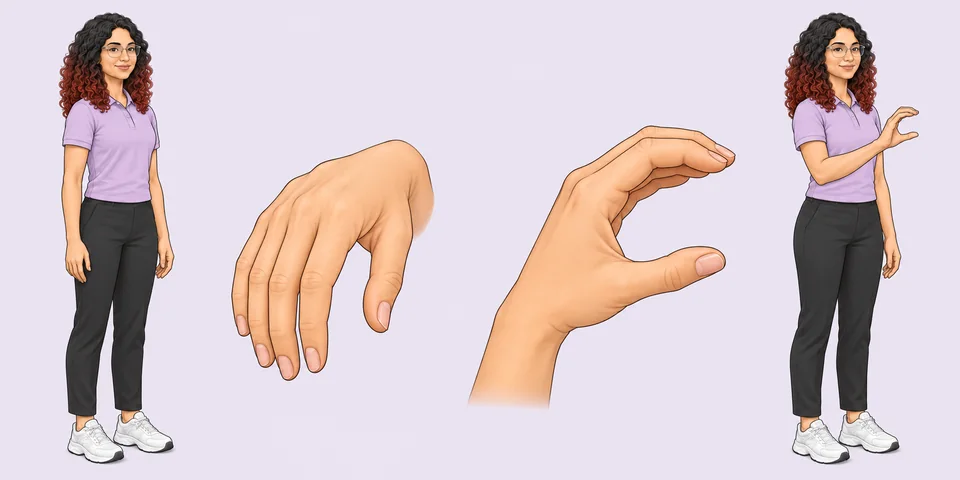
Dose: 5 holds of 5 seconds, once daily.
Use a gentle effort and do not pinch hard.
Level 2 · Build capacity
Add a very small amount of resistance, if the joint tolerates it.
Open against a band
Use a very light loop around the thumb and fingers. Move the thumb away gently, then return slowly.

Dose: 1 set of 5–8, on 2–3 days per week.
Use a tiny resistance and stop if joint pain increases.
Add a gentle grip
Wrap your fingers around soft putty or a soft ball. Squeeze lightly, then relax completely.

Dose: 1 set of 5–8, on 2–3 days per week.
Skip this if it increases pain at the thumb base.
Level 3 · Practise your tasks
Often the biggest wins here come from changing the task rather than the thumb.
Make the task easier
Try a jar aid or a wider handle to reduce hard pinching, and use two hands for heavier objects.

A hand therapist can advise on a fitted thumb-base support.
Practise a useful task
Choose a light household task with a comfortable grip. Use an aid if needed and pause before pain builds.
Dose: Start with one short, manageable task.
Build duration gradually rather than gripping harder.
Progressing without flaring things up
- Begin with comfortable movement and a gentle stability hold.
- Add light resistance only when the joint tolerates it, and avoid forceful pinching.
- If pain, swelling or stiffness remain worse afterwards, reduce the dose.
- Use larger handles, task breaks or a fitted thumb-base support when they help.
The aim here is comfortable function, not forcing the thumb into a perfect shape.
When to get checked first
Get assessed rather than starting these exercises if you have had a new injury, a red-hot swollen joint, a sudden loss of function, or persistent numbness. If you are not sure, NHS 111 can advise you.
Want a plan built around your hand?
Thumb base arthritis usually responds best to a mix of gentle loading, task changes and sometimes a fitted support. At our Warrington clinic we work out that mix with you. No GP referral needed.
Book an assessmentRead next
- Thumb base osteoarthritis — what it is, how we assess it and how we treat it
- Hand and wrist pain physiotherapy in Warrington — other causes and what helps
Sources and limits
Primary research and clinical guidelines were used where available, with NHS materials supporting the practical instructions. The exercises, their order and the starting doses are our adaptation of that guidance rather than a protocol tested as a whole in a trial. The levels are flexible menus, not fixed healing stages or a promise of a cure. This article explains a condition after assessment; it cannot diagnose you.
- Kloppenburg M, et al. (2019) — 2018 update of the EULAR recommendations for the management of hand osteoarthritis. Annals of the Rheumatic Diseases. ard.bmj.com/content/78/1/16
- St George's University Hospitals NHS Foundation Trust — Thumb stability exercises. stgeorges.nhs.uk/wp-content/uploads/2025/03/THE_
Reviewed 28 November 2026 by Arya Kenkre, HCPC PH144505.