

Why the outer elbow hurts
The wrist-extensor tendons attach near the outer elbow. When they become sensitive, gripping and lifting provoke pain there.
Tingling, numbness or neck-related pain point to something else and need a different assessment.
This plan is for lateral elbow tendinopathy that has been assessed. Desk pain alone does not establish the diagnosis.
How to use this plan
Pick one or two exercises that suit you right now. You do not need to do all six, and you should not work through every level in one session.
Treat the sets and reps as a starting point rather than a prescription. How much weight you use and how often you do it should fit you.
Move up a level when an exercise starts to feel easy and your elbow settles well the next day, rather than after a set number of weeks.
Level 1 · Find your start
Reduce the repeated gripping load before adding any exercise to it.
Change the daily load
Bring the mouse close and support your forearm. Use a relaxed grip and vary the tasks that demand most from your hand.

An ergonomic tool may help comfort, but it is not a cure on its own.
Hold the wrist steady
Support your forearm with the palm facing down, then press the back of your hand into your other hand.

Dose: 3 light holds of 10 seconds.
Keep the wrist still and ease off if pain builds.
Level 2 · Build capacity
Add slow, controlled resistance through the wrist and forearm.
Lift with the wrist
Support the forearm palm down with the wrist over the edge. Raise a very light weight, then lower slowly.
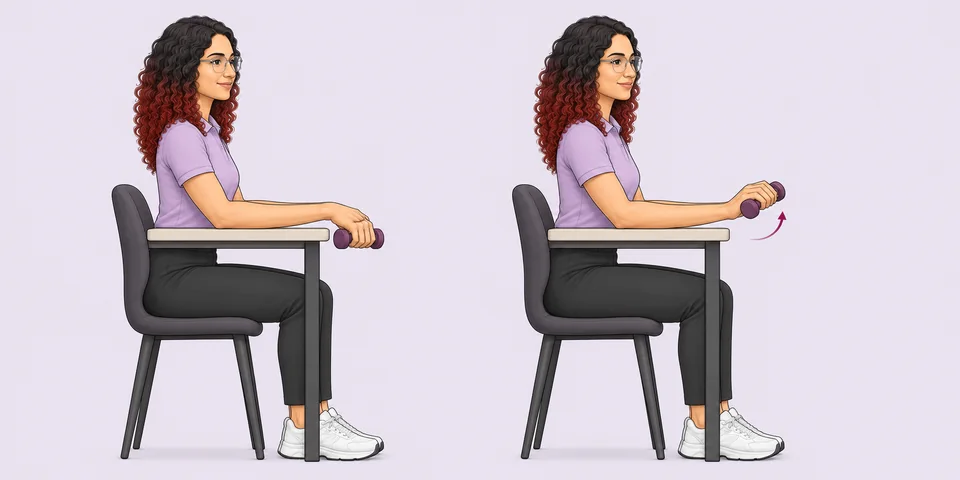
Dose: 1–2 sets of 8–12, on 2–3 days per week.
Move the wrist without twisting the forearm.
Turn the forearm
Support your forearm and keep the wrist straight. Turn a light weight palm up, then palm down.

Dose: 1–2 sets of 8–12, on 2–3 days per week.
Use a short, light weight and keep the motion controlled.
Level 3 · Practise your tasks
Rebuild the grip and carrying your day actually asks for.
Rebuild a gentle grip
Wrap your fingers around soft putty or a soft ball. Squeeze gently, then fully relax.

Dose: 1–2 sets of 6–10, on 2–3 days per week.
Avoid a maximal squeeze or a painful tight grip.
Return to carrying
Use a light bag in each hand with your wrists neutral. Walk a short distance, then put the bags down.

Dose: 2 carries of 20–30 seconds, 2–3 days weekly.
Increase only if your grip and next-day symptoms allow.
Progressing without flaring things up
- Reduce repeated high-load gripping without avoiding the arm altogether.
- Begin with a light hold or slow resistance you can control.
- Add weight or task duration gradually, one change at a time.
- If pain stays worse the next day, reduce the dose.
Exercise may help, but the benefits vary between people. No single grip trainer, band or device guarantees recovery, and it is worth a review if progress stalls or the diagnosis is unclear.
When to get checked first
Get assessed rather than starting these exercises if you have new numbness, progressive weakness, a major injury, or a red-hot swollen elbow with fever. If you are not sure, NHS 111 can advise you.
Want a plan built around your elbow?
Tennis elbow responds to the right load at the right time, and that is hard to judge alone. At our Warrington clinic we assess the elbow, the neck and your daily grip demands, then set the plan. No GP referral needed.
Book an assessmentRead next
- Tennis elbow — what it is, how we assess it and how we treat it
- Elbow pain physiotherapy in Warrington — other causes and what helps
Sources and limits
Primary research and clinical guidelines were used where available, with NHS materials supporting the practical instructions. The exercises, their order and the starting doses are our adaptation of that guidance rather than a protocol tested as a whole in a trial. The levels are flexible menus, not fixed healing stages or a promise of a cure. This article explains a condition after assessment; it cannot diagnose you.
- Lucado AM, et al. (2022) — Lateral elbow pain and muscle function impairments: clinical practice guideline. JOSPT. doi.org/10.2519/jospt.2022.0302
- Cochrane review (2024) — Manual therapy and exercise for lateral elbow pain. pmc.ncbi.nlm.nih.gov/articles/PMC11129914/
Reviewed 28 November 2026 by Arya Kenkre, HCPC PH144505.