

Persistent pain has many influences
Pain lasting more than three months can involve sensitivity, strength, sleep, stress and daily load all at once.
One posture or one scan finding rarely explains the whole picture. A graded plan can rebuild both confidence and capacity.
This plan is for non-specific neck pain that has been assessed. It is not a protocol for a recent injury, a worsening nerve problem or an unexplained headache.
How to use this plan
Pick one or two exercises that suit you right now. You do not need to do all six, and the phases can overlap.
Treat the sets and reps as a starting point rather than a prescription. Keep the effort light and the range comfortable.
Move on when a movement feels controlled and your symptoms settle to their usual level, rather than after a set number of weeks.
Phase 1 · Explore comfortable movement
Find the movement you have, without forcing the range.
Explore the turn
Turn your head slowly towards one shoulder, return to centre, and repeat to the other side.

Dose: 5 comfortable turns each side.
Keep your shoulders still and stop for dizziness or new tingling.
Glide the head back
Look ahead and gently draw your head backwards, making a clear double chin without nodding down.
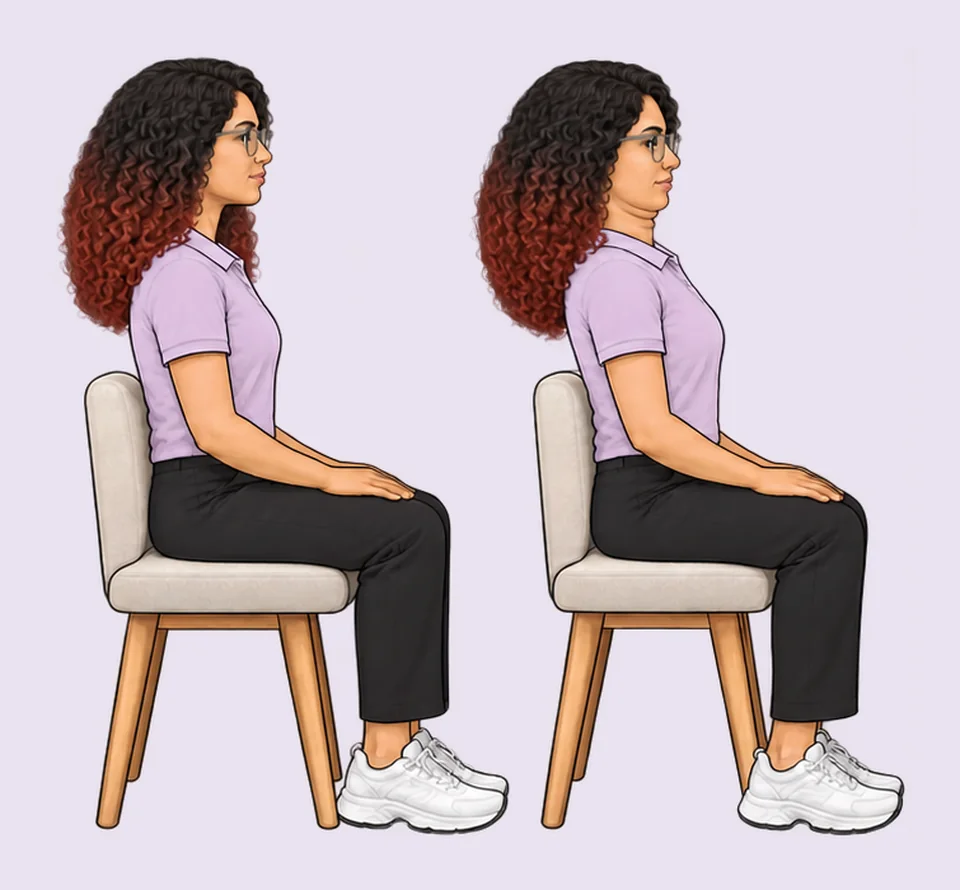
Dose: 5 repetitions, holding for 3 seconds.
Keep your eyes level and do not tip the head backwards.
Phase 2 · Build control and light strength
Small, supported work for the deep neck muscles.
Practise a small nod
Lie with your head resting and support the neck if needed. Nod gently as if saying yes, keeping the head resting down.

Dose: 5 holds of 5 seconds, with rests.
Use a small motion and do not lift the head.
Resist a gentle turn
Place a palm on your cheek and try to turn into your hand, keeping the head still. Repeat on the other side.

Dose: 3 holds of 5 seconds each side.
Use a light effort and do not push your head around.
Phase 3 · Build endurance and control
More demanding work against gravity. This phase is optional.
Control the head lift
Keep your shoulders supported near a firm bench edge. Tuck the chin and lift gently from slight extension.

Dose: 3–5 slow repetitions, on 2–3 days weekly.
Use a small range and stop for dizziness or arm symptoms.
Turn from all fours
On all fours, keep the neck in line with your upper back. Turn your head each way without lifting or dropping it.

Dose: 3–5 slow turns each side, on 2–3 days weekly.
Keep the trunk still and skip this if wrist or knee support is sore.
Progressing without flaring things up
- Phase 1: find comfortable neck movement without forcing the range.
- Phase 2: practise a small supported nod and light resisted turns.
- Phase 3: build controlled neck strength against gravity. The bench head lift is an optional, more demanding step.
- Reduce the dose if you stay worse the next day.
The phases can overlap. Choose one or two suitable exercises rather than doing every option together.
When to get checked first
Seek prompt assessment for progressive arm weakness or new balance problems. A sudden severe headache or stroke symptoms need emergency help. If you are not sure, NHS 111 can advise you.
Want a plan built around your neck?
Persistent neck pain usually needs more than exercises: sleep, daily load and confidence all feed into it. At our Warrington clinic we look at the whole picture and build the plan around it. No GP referral needed.
Book an assessmentRead next
- Mechanical neck pain — what it is, how we assess it and how we treat it
- Neck pain physiotherapy in Warrington — other causes and what helps
Sources and limits
Primary research and clinical guidelines were used where available, with NHS materials supporting the practical instructions. The exercises, their order and the starting doses are our adaptation of that guidance rather than a protocol tested as a whole in a trial. The levels are flexible menus, not fixed healing stages or a promise of a cure. This article explains a condition after assessment; it cannot diagnose you.
- Blanpied PR, et al. (2017) — Neck pain: revision 2017. Clinical practice guideline. JOSPT. doi.org/10.2519/jospt.2017.0302
- NHS inform — Exercises for neck problems. nhsinform.scot/illnesses-and-conditions/muscle-b
- South Tees Hospitals NHS Foundation Trust — Deep neck flexion in supine. southtees.nhs.uk/resources/deep-neck-flexion-in-
Reviewed 28 November 2026 by Arya Kenkre, HCPC PH144505.