

Why the side of the hip hurts
The gluteal tendons attach the side-hip muscles to the upper thigh bone. When they become sensitive, walking, stairs and lying on that side can all be painful.
Side-hip pain has other causes too, which is why an assessment matters before you start loading it.
This plan is for gluteal tendinopathy that has been assessed. The aim is to manage compression on the tendon and gradually build useful strength.
How to use this plan
Pick one or two exercises that suit you right now. You do not need to do all six, and you should not work through every level in one session.
Treat the sets and reps as a starting point rather than a prescription. How far you move, how much support you use and how often you do it should all fit you.
Move up a level when an exercise starts to feel easy and your hip settles well the next day, rather than after a set number of weeks.
Level 1 · Find your start
Before adding anything, take the repeated squeeze off the tendon.
Reduce the squeeze
Three positions compress the tendon against the bone, and avoiding them often settles things on its own.

Avoid sitting with one knee crossed over the other, hanging your weight onto one hip when standing, and lying directly on the painful side.
Press the knees out
Sit with your feet flat and a light band above your knees. Press your knees gently outwards and hold them still.

Dose: 3 holds of 10–20 seconds, with a light effort.
Use this only if it feels manageable.
Level 2 · Build capacity
Start adding load the tendon can handle, without leaning into the sore side.
Lift the leg sideways
Hold a secure chair and keep your pelvis level. Move the leg slightly sideways, then return slowly.
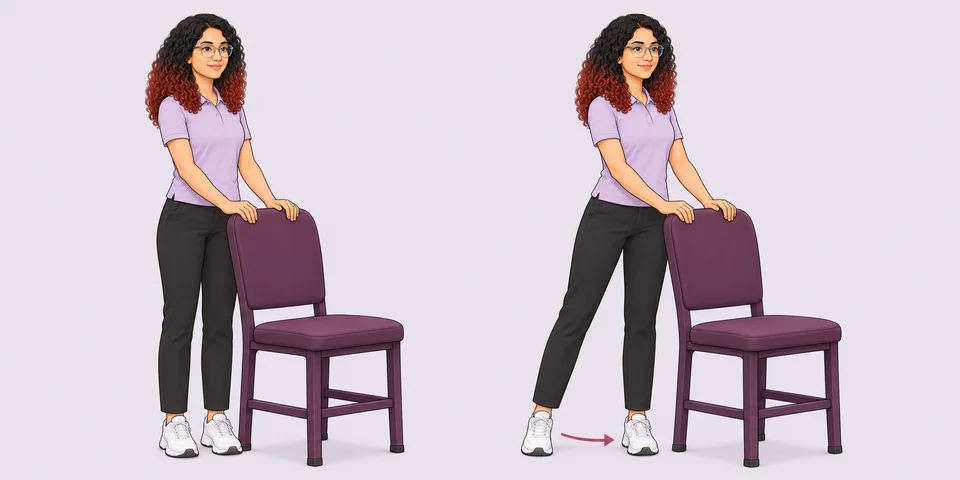
Dose: 1–2 sets of 8–12, on 2–3 days per week.
Keep your toes forwards and do not lean onto the sore hip.
Strengthen your rise
Use a stable chair with your feet comfortably apart. Stand, then sit slowly without dropping one hip.

Dose: 1–2 sets of 8–12, on 2–3 days per week.
Adjust the chair height to make the task manageable.
Level 3 · Practise your tasks
Build towards walking and stairs, the things that have been provoking it.
Take small side steps
Place a light band above your knees and take small side steps, keeping your feet apart.

Dose: 2 rounds of 5 steps each way, 2–3 days weekly.
Stay upright and stop before your hips start to sway.
Build stair strength
Hold a rail and place one foot on a low step. Step up and return slowly, keeping your pelvis level.

Dose: 1–2 sets of 5–8 each side, 2–3 days weekly.
Use a lower step if pain or control worsens.
Progressing without flaring things up
- Begin by reducing the positions that repeatedly compress the sore side of the hip.
- Choose a load you can manage without a lasting increase in pain or night symptoms.
- Progress towards walking, stairs and single-leg tasks gradually.
- If you are worse that night or the next morning, reduce the amount or the resistance and reassess.
Education combined with progressive exercise has trial support for this condition. The exact exercises here are adaptable examples rather than the only ones that work.
When to get checked first
Get assessed rather than starting these exercises if you have sudden severe pain after a fall, an inability to bear weight, a fever, or new leg weakness. If you are not sure, NHS 111 can advise you.
Want a plan built around your hip?
Outer hip pain settles fastest when the compression is managed and the load is pitched right. At our Warrington clinic we assess which is driving yours and set the levels to match. No GP referral needed.
Book an assessmentRead next
- Gluteal tendinopathy — what it is, how we assess it and how we treat it
- Hip pain physiotherapy in Warrington — other causes and what helps
Sources and limits
Primary research and clinical guidelines were used where available, with NHS materials supporting the practical instructions. The exercises, their order and the starting doses are our adaptation of that guidance rather than a protocol tested as a whole in a trial. The levels are flexible menus, not fixed healing stages or a promise of a cure. This article explains a condition after assessment; it cannot diagnose you.
- Mellor R, et al. (2018) — Education plus exercise versus corticosteroid injection use versus a wait and see approach on global outcome and pain from gluteal tendinopathy: the LEAP randomised clinical trial. BMJ. bmj.com/content/361/bmj.k1662
- Royal Orthopaedic Hospital NHS Foundation Trust — Gluteal tendinopathy and compression advice. roh.nhs.uk/services-information/therapy/gluteal-
Reviewed 28 November 2026 by Arya Kenkre, HCPC PH144505.