

Why those first steps hurt
The plantar fascia supports the arch under your foot. When it becomes sensitive, pain usually sits under the heel and is most noticeable after rest.
Not all heel pain is plantar fasciopathy, which is why it is worth having it assessed before you load it.
This plan is for plantar heel pain that has been assessed. Sudden injury, stress fracture and nerve-related symptoms need a different plan.
How to use this plan
Pick one or two exercises that suit you right now. You do not need to do all six, and you should not work through every level in one session.
Treat the sets and reps as a starting point rather than a prescription. How much you do and how often should fit you.
Move up a level when an exercise starts to feel easy and your first steps the next morning are no worse.
Level 1 · Find your start
Ease the tissue under the foot and the calf above it.
Stretch the foot gently
Rest the ankle across your other knee and support the heel. Gently draw the toes back to stretch the arch.

Dose: 3 holds of 20 seconds, once or twice daily.
The movement is toe extension, drawing the toes towards the shin.
Stretch the calf
Hands on the wall, step one foot behind you. Keep the rear knee straight and the heel flat, then lean in.

Dose: 2 holds of 20–30 seconds each side.
Keep the rear foot facing forwards.
Level 2 · Build capacity
Start loading the calf, choosing the version your heel tolerates.
Start a seated raise
Sit with your knees bent and toes resting on the floor. Lift your heels, then lower them slowly.

Dose: 1–2 sets of 8–12, on 2–3 days per week.
Use this easier option if standing raises are too sore.
Raise both heels
Hold a stable chair with your feet facing forwards. Rise onto your toes and lower slowly.
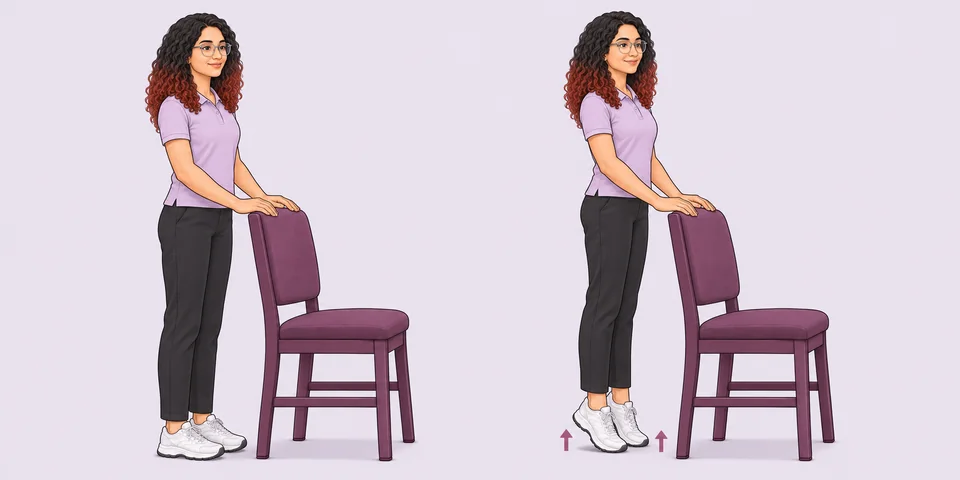
Dose: 1–2 sets of 8–12, on 2–3 days per week.
Keep the movement controlled and stay on a flat floor.
Level 3 · Practise your tasks
Build single-leg strength and rebuild the walking you want to do.
Build one-leg strength
Hold the chair and lift one foot clear of the floor. Raise and lower the working heel slowly.
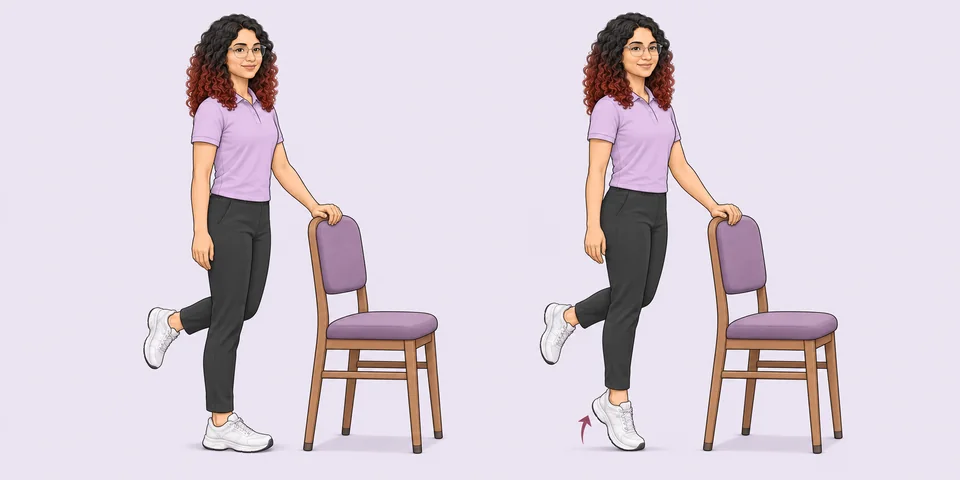
Dose: 1–2 sets of 5–8, on 2–3 days per week.
Use two legs if one-leg raises are too painful.
Rebuild your walking
Choose a short route and comfortable footwear. Walk at an easy pace and finish before pain builds.

Dose: Start with a duration you can repeat comfortably.
Track your first-step pain the next morning.
Progressing without flaring things up
- Start with suitable stretching and a calf-loading option you can manage.
- Choose one strength level; you do not need every heel-raise variation in one session.
- Increase resistance or walking duration gradually.
- If first-step pain stays worse the next morning, reduce the dose and rebuild.
Footwear, taping and other options may help alongside the exercise. Ask about support if walking remains limited despite a consistent plan.
When to get checked first
Get assessed rather than starting these exercises if you cannot bear weight, the pain followed a sudden injury, the foot is hot and swollen, or you have numbness or persistent night pain. If you are not sure, NHS 111 can advise you.
Want a plan built around your foot?
Heel pain has several possible causes, and the right loading differs for each. At our Warrington clinic we work out which one you have and set the plan around it. No GP referral needed.
Book an assessmentRead next
- Plantar fasciitis — what it is, how we assess it and how we treat it
- Foot and ankle pain physiotherapy in Warrington — other causes and what helps
Sources and limits
Primary research and clinical guidelines were used where available, with NHS materials supporting the practical instructions. The exercises, their order and the starting doses are our adaptation of that guidance rather than a protocol tested as a whole in a trial. The levels are flexible menus, not fixed healing stages or a promise of a cure. This article explains a condition after assessment; it cannot diagnose you.
- Koc TA, et al. (2023) — Heel pain and plantar fasciitis: clinical practice guideline. JOSPT. doi.org/10.2519/jospt.2023.0303
- United Lincolnshire Hospitals NHS Trust — Plantar fasciitis exercises. ulh.nhs.uk/patients/patient-information-library/
Reviewed 28 November 2026 by Arya Kenkre, HCPC PH144505.