

Why the shoulder feels stuck
The capsule around the shoulder joint becomes thickened and stiff. Reaching and turning the arm can become painful and limited.
Recovery varies from person to person. Exercise is one part of care, and pain relief may also help, particularly in the painful phase.
This plan is for frozen shoulder that has been assessed, without recent surgery or injury. Choose your level by how your shoulder feels, not by a fixed week-by-week calendar.
How to use this plan
Pick one or two exercises that suit you right now. You do not need to do all six, and you should not work through every level in one session.
Treat the sets and reps as a starting point rather than a prescription. How far you move, how much support you use and how often you do it should all fit you.
Move up a level when an exercise starts to feel easy and your shoulder settles well the next day, rather than after a set number of weeks.
Level 1 · Find your start
Assisted, supported movement for a shoulder that is sensitive or easily flared.
Slide with support
Rest your hands on a towel on a sturdy table. Slide forwards gently and let your body help the reach.
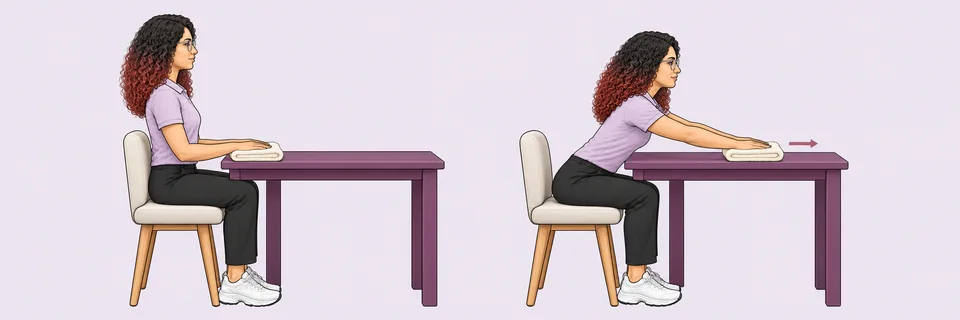
Dose: 5–10 comfortable repetitions, once daily.
In a painful phase, keep the range small.
Assist the rotation
Keep your elbows bent by your ribs and hold a stick. Use the easier arm to guide the other forearm outwards.

Dose: 5 gentle repetitions, holding for 5 seconds.
Stop before a sharp pain. Do not force the stick.
Level 2 · Build capacity
As the shoulder becomes less irritable, start exploring more reach and a little load.
Slide up the wall
Rest your hands on towels against the wall. Slide upwards within a tolerable range, then lower.

Dose: 5–10 slow repetitions, once daily.
Increase the reach only when the shoulder is less irritable.
Rebuild your reach
Lift your arms slightly forwards of sideways with thumbs up. Start without weights and add very light ones later.

Dose: 1–2 sets of 6–10, on 2–3 days per week.
Use a comfortable height and lower with control.
Level 3 · Practise your tasks
Once movement and light load are manageable, rebuild the strength your daily tasks need.
Add a little resistance
Keep your elbows by your ribs and turn your forearms outwards against a light band, returning slowly.

Dose: 1–2 sets of 8–12, on 2–3 days per week.
Add this when movement and light load are manageable.
Practise reaching up
Start with very light weights near your shoulders and press up only within the range you can control.

Dose: 1–2 sets of 6–8, on 2–3 days per week.
An optional later step, only when overhead reach allows.
Progressing without flaring things up
- Very painful or easily flared? Choose short, comfortable assisted movements.
- Less irritable but stiff? Gradually explore more reach without forcing the end range.
- As reach returns, build light resistance and the tasks you need.
- If pain or night symptoms stay worse after exercise, reduce the range or the amount.
Progress can be slow with a frozen shoulder. If pain is preventing movement or sleep, ask about the other treatment options available alongside exercise.
When to get checked first
Get assessed rather than starting these exercises if you have sudden weakness after an injury, a red-hot swollen joint, a fever, or new numbness. If you are not sure, NHS 111 can advise you.
Want a plan built around your shoulder?
Frozen shoulder responds best when the exercises match the stage you are actually in. At our Warrington clinic we work that out and set the level, range and doses to match. No GP referral needed.
Book an assessmentRead next
- Frozen shoulder — what it is, how we assess it and how we treat it
- Shoulder pain physiotherapy in Warrington — other causes and what helps
Sources and limits
Primary research and clinical guidelines were used where available, with NHS materials supporting the practical instructions. The exercises, their order and the starting doses are our adaptation of that guidance rather than a protocol tested as a whole in a trial. The levels are flexible menus, not fixed healing stages or a promise of a cure. This article explains a condition after assessment; it cannot diagnose you.
- British Elbow and Shoulder Society frozen shoulder pathway, 2025. doi.org/10.1177/17585732251335955
- British Elbow and Shoulder Society patient guidance. bess.ac.uk/frozen-shoulder/
Reviewed 28 November 2026 by Arya Kenkre, HCPC PH144505.