

Which part of the Achilles?
The Achilles connects the calf muscles to the heel bone. Midportion tendon pain usually sits a few centimetres above the heel.
Pain right at the heel attachment behaves differently and needs a different loading plan, so where it hurts matters.
This plan is for midportion Achilles tendinopathy that has been assessed. It is not a rupture, insertional pain or post-surgery protocol. Start on flat ground.
How to use this plan
Pick one or two loading options that suit you right now. You do not need to do all six, and you should not add every variation together.
Treat the sets and reps as a starting point rather than a prescription. The effort should be one you can tolerate and repeat.
Move up a level when an exercise starts to feel easy and your next-morning stiffness is no worse.
Level 1 · Find your start
Begin with both legs and a manageable effort.
Start with both heels
Hold a secure chair with both feet facing forwards. Raise both heels and lower slowly.
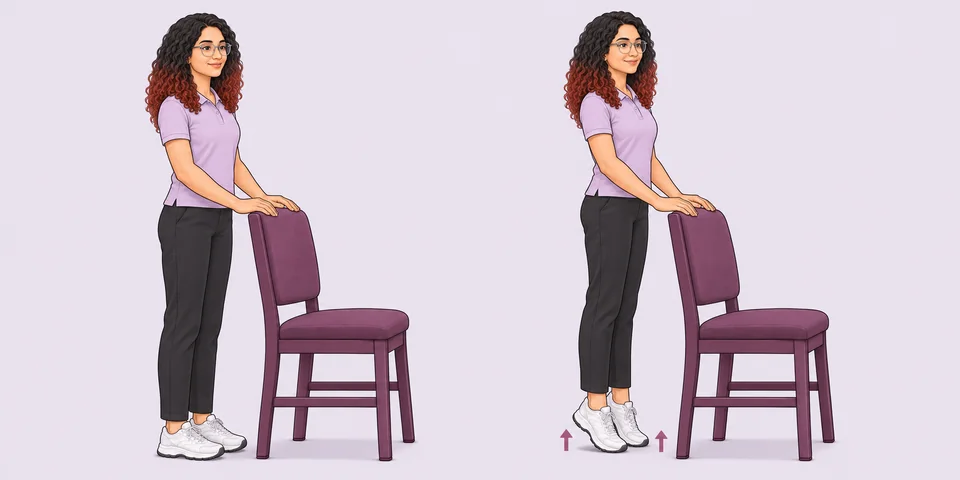
Dose: 2 sets of 8–12, on at least 3 days weekly.
Choose a manageable effort and use a flat floor.
Work the bent knee
Sit with your knees bent and forefeet planted. Raise the heels, pause, then lower slowly.

Dose: 2 sets of 10–15, on at least 3 days weekly.
This is a starting option; add load as it gets easier.
Level 2 · Build capacity
Progress to one leg, or add weight to the seated version.
Progress to one leg
Hold the chair and keep your other foot off the floor. Raise and lower the working heel slowly.
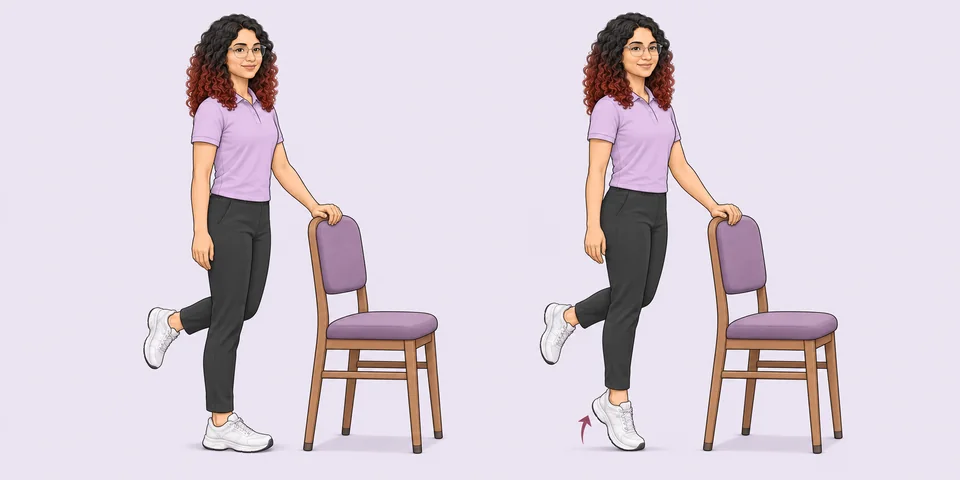
Dose: 2 sets of 6–10, on at least 3 days weekly.
Use two legs if you cannot control the movement.
Load the seated raise
Place a light padded weight above your knees and hold it steady as you raise and lower the heels.

Dose: 2–3 sets of 8–12, on at least 3 days weekly.
Keep pressure off the kneecaps and add weight gradually.
Level 3 · Practise your tasks
Add weight to the single-leg raise and rebuild your walking.
Add a little weight
Use a small backpack and hold the secure chair. Lift and lower one heel with control.

Dose: 2–3 sets of 6–10, on at least 3 days weekly.
Add load only when unweighted raises are manageable.
Build your walking
Choose a short route on a predictable surface. Build duration before adding speed or hills.

Dose: Start with a duration that does not cause a flare.
Running and jumping need a separate progression later.
Progressing without flaring things up
- Select one or two suitable loading options rather than adding every variation together.
- Build calf load at least three times weekly, at an effort you can tolerate.
- Track next-morning stiffness, pain and walking, and reduce the dose after a sustained flare.
- Progress resistance or task demand gradually.
There is no fixed number of weeks for each level. The tendon needs progressively useful load, and returning to sport usually needs faster loading beyond this pathway.
When to get checked first
A sudden pop, loss of push-off, or a new inability to rise onto your toes needs urgent assessment for a possible rupture. If you are not sure, NHS 111 can advise you.
Want a plan built around your Achilles?
Midportion and insertional Achilles pain need different loading, and getting that wrong stalls recovery. At our Warrington clinic we work out which you have and set the plan. No GP referral needed.
Book an assessmentRead next
- Achilles tendinopathy — what it is, how we assess it and how we treat it
- Foot and ankle pain physiotherapy in Warrington — other causes and what helps
Sources and limits
Primary research and clinical guidelines were used where available, with NHS materials supporting the practical instructions. The exercises, their order and the starting doses are our adaptation of that guidance rather than a protocol tested as a whole in a trial. The levels are flexible menus, not fixed healing stages or a promise of a cure. This article explains a condition after assessment; it cannot diagnose you.
- Martin RL, et al. (2024) — Midportion Achilles tendinopathy: clinical practice guideline. JOSPT. doi.org/10.2519/jospt.2024.0302
- Dutch multidisciplinary guideline on chronic Achilles tendinopathy. British Journal of Sports Medicine. bjsm.bmj.com/content/55/20/1125
Reviewed 28 November 2026 by Arya Kenkre, HCPC PH144505.