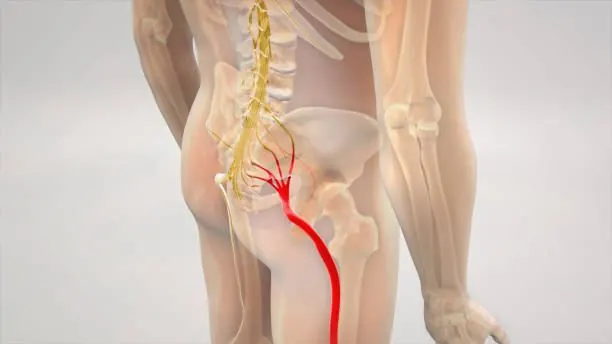

What Is Sciatica?
Sciatica is not a diagnosis in itself but a description of symptoms caused by irritation or compression of the sciatic nerve — the longest nerve in the body, running from the lower spine through the buttock and down each leg to the foot. When this nerve is compressed or irritated, it produces the characteristic pattern of pain, numbness, tingling or weakness that radiates along its path.
The most common cause of sciatica is a herniated or prolapsed disc in the lumbar spine, where the soft inner material of an intervertebral disc pushes through the outer casing and presses on the nerve root. Other causes include lumbar spinal stenosis, where the spinal canal narrows and compresses the nerve, piriformis syndrome, where the piriformis muscle in the buttock irritates the sciatic nerve, and degenerative changes in the lumbar spine.
Symptoms of Sciatica
Sciatica typically affects one side of the body and produces a distinctive pattern of symptoms that distinguishes it from general lower back pain. Common symptoms include:
- Pain radiating from the lower back through the buttock and into the leg, sometimes as far as the foot
- A burning, shooting or electric shock sensation along the nerve pathway
- Numbness or tingling in the leg, calf or foot
- Muscle weakness in the affected leg
- Pain that worsens with prolonged sitting, bending forward or coughing and sneezing
- In severe cases, difficulty walking or standing for any length of time
It is important to seek urgent medical attention if you experience loss of bladder or bowel control, new sexual dysfunction or perineal numbness alongside back and leg pain, as this combination may indicate a serious condition called cauda equina syndrome that requires immediate referral and assessment (NICE NG127, 2019).
How Physiotherapy Treats Sciatica
Physiotherapy is recommended as part of first-line management for sciatica in the vast majority of cases. A thorough physiotherapy assessment will identify the likely source of nerve irritation, the severity of your symptoms and any factors contributing to your presentation, forming the basis of a personalised treatment plan.
Treatment typically combines several approaches depending on your individual presentation. Manual therapy techniques including spinal mobilisation and soft tissue treatment can reduce nerve irritation and improve movement, though NICE guidance specifically recommends manual therapy only as part of a wider treatment package that includes exercise, rather than as a standalone treatment (NICE NG59, 2020). Neural mobilisation exercises gently move the sciatic nerve through its full range to reduce sensitivity and restore normal nerve mechanics. Targeted exercise prescription addresses the underlying muscle imbalances and movement patterns contributing to nerve compression. Education about posture, movement and activity modification helps you manage symptoms day to day and reduces the risk of recurrence.
The evidence on which specific physiotherapy approach works best is still developing — a 2022 systematic review and meta-analysis found the trials to date provide an inconsistent picture, with a small benefit for pain reduction over minimal intervention at long-term follow-up but no clear difference between physiotherapy and control treatments at earlier time points (Dove et al., PMC9925551, 2022). What is clear is that without appropriate management, sciatica can become persistent: the same review found that up to 45% of people continue to experience symptoms for 12 months or longer (Dove et al., PMC9925551, 2022), which underlines the value of early, structured assessment.
What to Expect from Sciatica Physiotherapy at Iris Physio
At Iris Physio we assess and treat sciatica at our clinics in Warrington and Nottingham. Your initial assessment will include a detailed history of your symptoms, a thorough physical examination of your lumbar spine, neural tension tests to assess sciatic nerve irritability and a functional assessment of your movement and strength.
From there your physiotherapist will design a personalised treatment plan and begin hands-on treatment in the same session where appropriate. You will always see your dedicated physiotherapist — the same clinician at every visit, who monitors your progress and adapts your programme as your symptoms change.
No GP referral is needed. We aim to see patients within three to five days of enquiry. Home visits are available on demand from £80 for patients who find attending a clinic difficult during the acute phase of their symptoms.
Frequently Asked Questions About Sciatica
Recovery time varies widely between individuals. Many people improve within a matter of weeks with appropriate physiotherapy, but up to 45% of people continue to experience some symptoms at 12 months (Dove et al., PMC9925551, 2022). Severe or long-standing presentations tend to take longer, which is why early physiotherapy assessment is recommended.
Staying as active as your symptoms allow is generally recommended. NICE guidance advises against prolonged rest and instead recommends encouraging patients to continue with normal activities wherever possible (NICE NG59, 2020). Your physiotherapist will advise on appropriate activity levels and provide specific exercises that help rather than aggravate your symptoms.
In most cases, no. NICE guidance advises against routinely offering imaging in non-specialist settings, recommending it only in specialist settings where the result is likely to change management, or where red flags for serious underlying pathology are present (NICE NG59, 2020). The majority of sciatica presentations can be accurately assessed and effectively treated through physiotherapy without imaging.
Prolonged sitting can contribute to sciatica by increasing pressure on the lumbar discs and compressing the sciatic nerve, particularly if your sitting posture is poor. It is one of several contributing factors rather than a direct cause in most cases. Your physiotherapist will assess your posture and working environment as part of your treatment.
Physiotherapy significantly reduces the risk of recurrence by addressing the underlying causes of nerve irritation and equipping you with the knowledge and exercises to maintain your recovery independently. Some people do experience recurrent episodes, particularly if contributing factors such as prolonged sitting or poor movement patterns are not addressed.
Not exactly. A slipped disc — more accurately called a herniated or prolapsed disc — is one of the most common causes of sciatica, but sciatica can also be caused by other conditions including spinal stenosis and piriformis syndrome. Your physiotherapist will assess the likely cause of your symptoms and tailor your treatment accordingly.
Struggling with Back and Leg Pain?
If you are experiencing pain, numbness or tingling radiating from your lower back into your leg, early physiotherapy assessment gives you the best chance of a fast and complete recovery. Our HCPC registered physiotherapists at Iris Physio's Warrington and Nottingham clinics are experienced in the assessment and treatment of sciatica and lumbar nerve conditions.
References Used in This Revision
- NICE NG59 (2020) — Low back pain and sciatica in over 16s: assessment and management. nice.org.uk/guidance/ng59
- NICE NG127 (2019) — Suspected neurological conditions: recognition and referral. nice.org.uk/guidance/ng127
- Dove L, et al. (2022) — How effective are physiotherapy interventions in treating people with sciatica? A systematic review and meta-analysis. European Spine Journal. PMC9925551. pmc.ncbi.nlm.nih.gov/articles/PMC9925551
- Ryan C, Pope CJ, Roberts L (2020) — Why managing sciatica is difficult: patients' experiences of an NHS sciatica pathway. A qualitative, interpretative study. BMJ Open. PMC7295411. pmc.ncbi.nlm.nih.gov/articles/PMC7295411