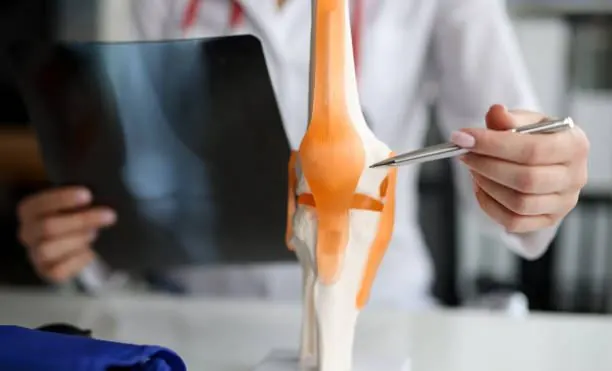

What Is Knee Osteoarthritis?
Knee osteoarthritis (OA) is a condition in which the cartilage cushioning the knee joint gradually wears down, leading to pain, stiffness and reduced mobility. It is one of the most common causes of joint pain in older adults, affecting an estimated 5.4 million people in the UK (Versus Arthritis, 2024), and it becomes substantially more common with age. It is characterised by pain, stiffness, swelling and reduced mobility, particularly in the morning or after prolonged sitting.
Severity is typically graded on imaging (X-ray or MRI), but it's important to know that imaging findings don't always correlate with symptoms. Many people with significant arthritis on imaging have mild symptoms, and vice versa.
What Does Physiotherapy Offer?
Physiotherapy for knee OA is not a temporary fix, it addresses the underlying drivers of pain and dysfunction. A structured programme typically combines several of the following:
- Strengthening the quadriceps and surrounding muscles, quadriceps (knee extensor) weakness is a recognised risk factor for the onset and progression of knee OA (Øiestad et al., 2022). Stronger muscles reduce joint loading and pain.
- Weight management support, research suggests that for every kilogram of body weight lost, knee joint loading during walking reduces by roughly four times that amount (Messier et al., 2005), making even modest weight loss meaningful for symptom control. Physiotherapy supports activity-based weight management.
- Improving joint mobility and reducing stiffness, manual therapy and targeted stretching restore range of movement.
- Education and self-management, understanding your condition and how to pace activity is transformative for long-term quality of life.
What Does Surgery Offer?
For end-stage knee OA that has failed to respond to conservative management, total knee replacement (TKR) is a highly effective procedure that reliably reduces pain and improves function. UK National Joint Registry data shows the large majority of patients are satisfied with their outcome, and most replacements remain in good working order for many years (National Joint Registry, 2025).
However, it carries risks (infection, DVT, nerve damage, implant failure), requires significant rehabilitation, and is not reversible. NICE guideline NG226 on osteoarthritis in over-16s recommends that clinicians offer therapeutic exercise and weight management first, and advises considering referral for joint replacement only once non-surgical management is "ineffective or unsuitable" and symptoms are substantially affecting quality of life (NICE NG226, 2022).
What Does the Evidence Say?
The honest answer is more nuanced than "physiotherapy works just as well as surgery." High-quality trials show that for advanced knee OA, surgery can outperform non-surgical treatment, while for earlier-stage disease, exercise-based physiotherapy often performs comparably to surgery, which is why it remains the recommended first step for most patients.
A landmark Danish trial published in the New England Journal of Medicine randomised patients with moderate-to-severe knee OA to either total knee replacement plus non-surgical treatment, or non-surgical treatment (supervised exercise, education, diet advice, insoles and pain medication) alone. At 12 months, the surgery group had significantly greater improvement in knee function and pain than the non-surgical group. However, surgery also carried a notably higher rate of serious adverse events such as infection and blood clots (24 events vs 6) (Skou et al., 2015). Around a quarter of patients allocated to non-surgical treatment chose to proceed to surgery within that first year, while the remainder still improved meaningfully without it.
Separately, a JAMA-published Dutch trial (the ESCAPE trial) found that for degenerative meniscal tears, a condition closely linked to early knee OA, exercise-based physiotherapy was noninferior to arthroscopic surgery for knee function, with comparable rates of osteoarthritis progression at five years (van de Graaf et al., 2022). Surgery is clearly indicated for severe, end-stage disease that hasn't responded to conservative care, but for earlier-stage OA, physiotherapy and lifestyle modification remain the first-line recommendation of major international guidelines.
The Bottom Line
Physiotherapy is not simply "buying time" before surgery. For the majority of knee OA patients, particularly those with mild to moderate disease, it represents a safe, effective and evidence-based first-line treatment, with surgery available as a highly effective option if conservative care doesn't provide enough relief. A structured programme, delivered by an experienced physiotherapist in your home, can produce significant and lasting improvements in pain, mobility and quality of life.
Knee Pain in Manchester, Liverpool, Chester or Warrington?
Book a home assessment with Iris Physio and find out what physiotherapy can do for your knee OA.
Book a Home Visit →References Used in This Revision
- Versus Arthritis (2024) — Research breakthrough shows hope for millions afflicted by osteoarthritis pain (cites Versus Arthritis UK prevalence data: 5.4 million people with knee OA in the UK). arthritis-uk.org
- Øiestad BE, et al. (2022) — Knee extensor muscle weakness is a risk factor for the development of knee osteoarthritis: an updated systematic review and meta-analysis including 46,819 men and women. British Journal of Sports Medicine. pubmed.ncbi.nlm.nih.gov/34916210
- Messier SP, et al. (2005) — Weight loss reduces knee-joint loads in overweight and obese older adults with knee osteoarthritis. Arthritis & Rheumatism. pubmed.ncbi.nlm.nih.gov/15986358
- National Joint Registry (2025) — NJR 22nd Annual Report 2025. njrcentre.org.uk
- NICE (2022) — Osteoarthritis in over 16s: diagnosis and management, NICE guideline NG226. nice.org.uk/guidance/ng226
- Skou ST, et al. (2015) — A Randomized, Controlled Trial of Total Knee Replacement. New England Journal of Medicine. pubmed.ncbi.nlm.nih.gov/26488691
- van de Graaf VA, et al. (2022) — Effect of Physical Therapy vs Arthroscopic Partial Meniscectomy in People With Degenerative Meniscal Tears: Five-Year Follow-up of the ESCAPE Randomized Clinical Trial. JAMA Network Open. pubmed.ncbi.nlm.nih.gov/35802374