
Common Ankle Surgeries and What They Involve
Ankle surgery covers a range of procedures, from fracture fixation to ligament repair and joint replacement, each with a different rehabilitation timeline. The five most common types are:
- Ankle fracture fixation (ORIF): Open reduction and internal fixation with plates and screws to stabilise a fractured ankle. One of the most common ankle surgeries.
- Lateral ligament repair (Brostrom procedure): Surgical tightening or reconstruction of the lateral ankle ligaments following chronic instability.
- Achilles tendon repair: Surgical reattachment of a fully ruptured Achilles tendon, a significant procedure with a lengthy rehabilitation protocol.
- Ankle arthroscopy: Keyhole surgery to address impingement, loose bodies, osteochondral defects or synovitis within the ankle joint.
- Total ankle replacement: Replacement of the ankle joint with a prosthesis, used for end-stage ankle arthritis.
The Non-Weight-Bearing Phase
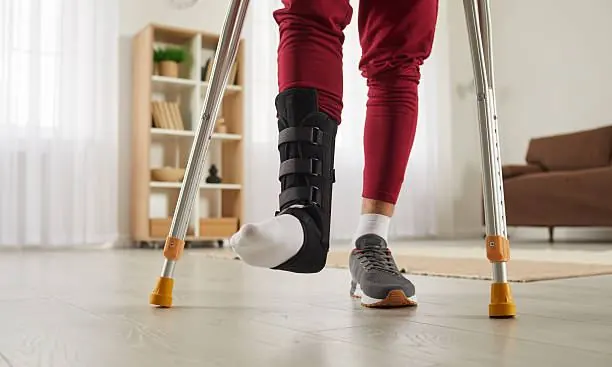
Many ankle surgeries require a period of non-weight-bearing while the bone or soft tissue repair heals, though current UK guidance favours earlier weight-bearing than was traditionally recommended. NHS guidance states that most patients can be allowed to bear weight as tolerated unless there are specific concerns about fixation stability or soft tissue healing, while some fractures and more complex repairs still require a longer period of restricted weight-bearing of up to 6 weeks or more (BOAST 12, British Orthopaedic Association, 2016). During this phase, mobility is limited to crutches, knee scooters or wheelchairs. This presents a significant logistical challenge for clinic-based physiotherapy.
In the non-weight-bearing phase, physiotherapy focuses on:
- Oedema management, elevation, compression and gentle ankle movements within the permitted range to reduce swelling
- Maintaining strength in the non-operated leg, hips and core, essential for when weight-bearing resumes
- Upper limb conditioning to manage crutch use safely
- Proprioception exercises for the upper body and non-operated leg
- Education on safe transfers, stairs and daily activities on crutches
Returning to Weight-Bearing (Weeks 6–12)
When cleared by your surgeon to begin weight-bearing, the transition must be gradual and carefully supervised:
- Partial weight-bearing with crutches, progressing to full weight-bearing as comfort allows
- Gait re-education, re-learning a normal walking pattern after weeks of crutch use
- Ankle range-of-motion exercises, dorsiflexion (upward movement) is often most restricted and critical to restore
- Progressive strengthening of the calf, peroneal muscles and intrinsic foot muscles
- Scar tissue mobilisation once the wound is fully healed
The Strengthening and Balance Phase (Months 3–6)
Ankle surgery, particularly ligament repairs, leaves significant proprioceptive (balance and position sense) deficits that must be systematically addressed:
- Single-leg balance training on progressively unstable surfaces
- Calf raise progression, double-leg to single-leg, from flat to incline
- Functional movement patterns, squats, lunges, step-ups
- Return to walking on uneven surfaces
- Gradual return to walking longer distances
Achilles Tendon Repair: A Special Case
Achilles rupture repair has one of the most protocol-driven rehabilitation programmes in orthopaedics. Graduated tendon loading must follow a precise timeline:
- Weeks 0–2: Strict non-weight-bearing in a boot, ankle in plantarflexion (pointing down)
- Weeks 2–6: Boot with heel wedges gradually reduced; partial weight-bearing commences
- Weeks 6–12: Progressive weight-bearing, transition out of boot
- Months 3–6: Calf strengthening, proprioception, return to low-impact activity
- Months 6–12: Return to running and sport (if applicable)
Why Non-Weight-Bearing Patients Need Home Visits
If you're on crutches and cannot drive, getting to a clinic for physiotherapy appointments is either impossible or genuinely hazardous. A home visit physiotherapist removes this barrier entirely, coming to your home, assessing your real living environment, and ensuring you're rehabilitating safely and progressing optimally without the stress of travel.
Recovering from Ankle Surgery in Manchester, Liverpool, Chester or Warrington?
We come to you, even if you're non-weight-bearing. Book a home visit and start your rehabilitation from day one.
Book a Home Visit →References Used in This Revision
- British Orthopaedic Association (2016) — BOAST 12: The Management of Ankle Fractures. boa.ac.uk/resource/boast-12-pdf.html