
What Is the ACL and How Does It Get Injured?
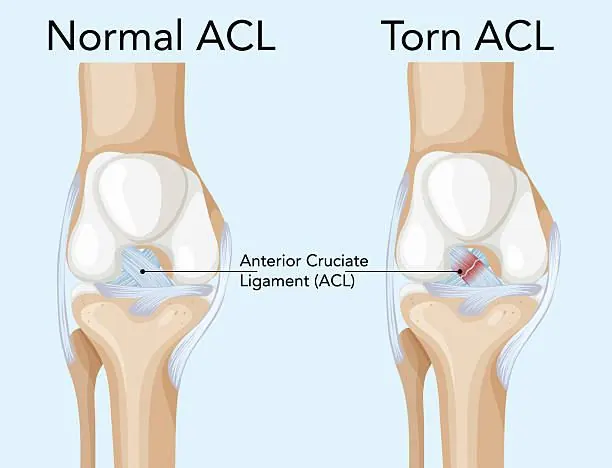
The anterior cruciate ligament (ACL) is one of the four main ligaments stabilising the knee joint, and an ACL injury is a tear or rupture of this ligament that commonly occurs during sport. It runs diagonally through the middle of the knee and is responsible for controlling rotational movement and preventing the tibia from sliding forward relative to the femur.
ACL injuries most commonly occur during sports involving sudden changes of direction, jumping and landing, or direct contact — such as football, rugby, skiing and netball. Just over half of ACL injuries happen without any contact from another player, typically when the knee is twisted while the foot is planted on the ground (Chia et al., PMC9136558, 2022). Many people report hearing or feeling a pop at the moment of injury, followed by rapid swelling and significant instability in the knee.
ACL Reconstruction — Do You Need Surgery?
Not all ACL injuries require surgery. For less active individuals or those with partial tears, conservative management through physiotherapy alone can restore sufficient stability for daily life. However, for athletes and those wishing to return to high-demand sport, ACL reconstruction surgery is generally recommended.
ACL reconstruction involves replacing the torn ligament with a graft, most commonly taken from the patella tendon or hamstring tendon. The decision between surgical and conservative management should be made in consultation with your orthopaedic consultant and physiotherapist, taking into account your activity levels, age, the degree of instability and your recovery goals.
ACL Rehabilitation Stages
Stage 1 — Acute Phase (Weeks 1 to 2)
The immediate priority following ACL injury or reconstruction is managing pain and swelling, protecting the healing tissue and beginning to restore basic movement. Your physiotherapist will guide you through gentle range of movement exercises, quadriceps activation and weight bearing progression. The goal at this stage is to reduce swelling, regain full knee extension and establish a foundation for the progressive loading that follows.
Stage 2 — Strength and Stability (Weeks 2 to 12)
As pain and swelling settle, rehabilitation becomes progressively more demanding. The focus shifts to rebuilding quadriceps and hamstring strength, improving neuromuscular control and restoring normal walking patterns. Closed chain exercises such as squats, leg press and step work form the foundation of this phase. Balance and proprioception training — retraining the knee's ability to sense and respond to movement — is introduced progressively throughout this stage.
Stage 3 — Functional Rehabilitation (Months 3 to 6)
By three months post-surgery, rehabilitation typically progresses to more functional and sport-specific training. Running is introduced gradually, beginning with straight-line jogging and progressing to changes of direction as strength and confidence build. Criteria-based progression — advancing based on achieving measurable strength and movement targets rather than time alone — is central to safe rehabilitation at this stage.
Stage 4 — Return to Sport (Months 6 to 12)
Return to sport following ACL reconstruction is not simply a matter of waiting long enough — it depends on meeting objective strength and movement criteria. A cohort study of patients returning to pivoting sport found that using criteria-based return to sport testing, alongside delaying return until at least nine months post-surgery, was associated with an 84% reduction in knee reinjury rate (Grindem et al., PMC4912389, 2016). At Iris Physio we use validated return to sport criteria to assess readiness, including limb symmetry indices for strength and hop tests for functional performance. Most athletes return to full sport between nine and twelve months post-surgery.
How Iris Physio Supports ACL Rehabilitation
At Iris Physio we provide specialist ACL rehabilitation at our clinics in Warrington and Nottingham. Our lead sports and MSK physiotherapist Aysha Salam has specialist training in physiotherapy for athletes and sports-related MSK conditions, with particular expertise in lower limb rehabilitation and return to sport programmes.
Every ACL rehabilitation programme at Iris Physio is personalised to the individual — your surgery, your sport, your current physical condition and your goals. Sessions are one-to-one with your dedicated physiotherapist at every appointment. We work alongside your orthopaedic consultant's guidance and can share progress notes with your surgical team throughout your recovery.
No GP referral is needed. We aim to see patients within three to five days of enquiry.
Frequently Asked Questions About ACL Rehabilitation
ACL rehabilitation typically takes nine to twelve months for those returning to high-demand sport. For those returning to lower-demand activity, meaningful recovery can be achieved in six to nine months. The timeline depends on the degree of injury, whether surgery was performed, your starting fitness level and how consistently you engage with your rehabilitation programme.
Yes, in some cases. Conservative ACL rehabilitation through physiotherapy alone can restore sufficient stability for daily life and lower-demand activity. Whether surgery is appropriate depends on your activity goals, the degree of instability and your orthopaedic consultant's assessment. Your physiotherapist can help you understand your options.
Most patients begin straight-line jogging between three and four months post-surgery, provided they meet the strength and movement criteria for safe running. Return to sport-specific running and change of direction work typically follows between five and seven months. Your physiotherapist will assess your readiness rather than progressing based on time alone.
The risk of ACL re-injury is significantly elevated in the twelve months following return to sport, particularly in younger athletes — one study of athletes under 20 found 18% sustained a reinjury to either knee after returning to high-risk sport (Barber-Westin & Noyes, PMC7785893, 2020). Completing a full, criteria-based rehabilitation programme and not returning to sport prematurely are important factors in reducing re-injury risk, though even athletes who pass return-to-sport testing are not fully protected against reinjury — testing has been shown to reduce the risk of graft rupture specifically, rather than all forms of reinjury (Zhou et al., PMC11064852, 2024).
Yes. Pre-operative physiotherapy before ACL reconstruction has been shown to improve post-operative outcomes. A systematic review found prehabilitation groups had higher return-to-sport rates and significantly better self-reported knee function at two years post-surgery than those who did not complete prehabilitation (Giesche et al., PMC7592749, 2020). Strengthening the quadriceps and hamstrings before surgery means you begin your recovery from a stronger baseline. We offer prehabilitation programmes at all three clinic locations.
Absolutely. ACL injuries affect people of all activity levels. Whether you are a competitive athlete or simply want to return to walking comfortably, our rehabilitation programmes are tailored entirely to your goals and lifestyle.
Ready to Start Your ACL Recovery?
Whether you are in the early stages of ACL injury or preparing for return to sport, Iris Physio's HCPC registered physiotherapists are here to support your recovery at every stage. Book your initial assessment at our Warrington or Nottingham clinic today.
References Used in This Revision
- Yao S, et al. (2021) — Graft healing after anterior cruciate ligament reconstruction (ACLR). Asia-Pacific Journal of Sports Medicine, Arthroscopy, Rehabilitation and Technology. PMC8134949. pmc.ncbi.nlm.nih.gov/articles/PMC8134949
- Chia L, et al. (2022) — Non-contact Anterior Cruciate Ligament Injury Epidemiology in Team-Ball Sports: A Systematic Review with Meta-analysis. Sports Medicine. PMC9136558. pmc.ncbi.nlm.nih.gov/articles/PMC9136558
- Grindem H, Snyder-Mackler L, Moksnes H, Engebretsen L, Risberg MA (2016) — Simple decision rules can reduce reinjury risk by 84% after anterior cruciate ligament reconstruction: the Delaware-Oslo ACL cohort study. British Journal of Sports Medicine. PMC4912389. pmc.ncbi.nlm.nih.gov/articles/PMC4912389
- Barber-Westin S, Noyes FR (2020) — One in 5 Athletes Sustain Reinjury Upon Return to High-Risk Sports After ACL Reconstruction: A Systematic Review in 1239 Athletes Younger Than 20 Years. Sports Health. PMC7785893. pmc.ncbi.nlm.nih.gov/articles/PMC7785893
- Zhou J, et al. (2024) — Association between passing return-to-sport testing and re-injury risk in patients after anterior cruciate ligament reconstruction surgery: a systematic review and meta-analysis. PeerJ. PMC11064852. pmc.ncbi.nlm.nih.gov/articles/PMC11064852
- Giesche F, Niederer D, Banzer W, Vogt L (2020) — Evidence for the effects of prehabilitation before ACL-reconstruction on return to sport-related and self-reported knee function: A systematic review. PLOS ONE. PMC7592749. pmc.ncbi.nlm.nih.gov/articles/PMC7592749